Segmental Doppler pressure testing measures the blood pressure in an arm or a leg at certain points. It uses Doppler ultrasound. This imaging tool sends sound waves through your body. It's used to check blood flow in an artery.
Why segmental Doppler pressure testing is done
You may need this test if you have peripheral artery disease (PAD). PAD occurs when the flow of blood through the arteries in your arms or legs is slowed because of a blockage. This test can find a blockage in those arteries. It can also see how bad the blockage is.
PAD is the result of atherosclerosis. That’s the buildup of plaque in the arteries. Plaque is the buildup of fat, cholesterol, and other substances in the blood that can narrow the arteries. It can lead to heart problems, such as a heart attack.
How segmental Doppler pressure testing is done
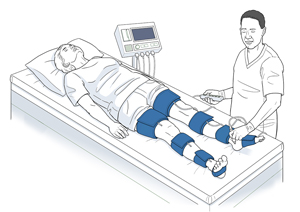
You usually have this test as an outpatient. That means you can go home afterward. During the test:
-
You lie down on an exam table.
-
You will rest for 15 minutes to allow your blood pressure to stabilize. During this time, you may be asked about your health and any symptoms.
-
A healthcare provider then wraps 3 to 4 blood pressure cuffs around your arm or leg. The cuffs are spaced evenly across your limb. On a leg, they are most often put around the thigh, the calf, right above the ankle, and across the top of the foot. On an arm, they are placed over the bicep, on the forearm, and on the wrist.
-
The healthcare provider prepares the ultrasound. They put some gel on your arm or leg near certain arteries. The gel helps the ultrasound’s probe (transducer) work better.
-
The healthcare provider pumps up and slowly deflates one of the cuffs. Then they move the probe over your skin to check blood flow at that spot. The provider repeats this step for all of the cuffs.
-
You may feel some discomfort from the probe. But the test should not hurt.
Blood pressure is measured in millimeters of mercury (mmHg). A 20-mmHg difference between two points on your leg can show where you may have a block in blood flow. In an arm, that difference is 10 mmHg between two points.
Author: Semko, Laura
Online Medical Reviewer: Anne Fetterman RN BSN
Online Medical Reviewer: Deepak Sudheendra MD
Online Medical Reviewer: Raymond Kent Turley BSN MSN RN
Date Last Reviewed: 12/01/2022
© 2000-2025 The StayWell Company, LLC. All rights reserved. This information is not intended as a substitute for professional medical care. Always follow your healthcare professional's instructions.
Find the right provider to meet your needs
From primary care to specialty services and more.
Find a Doctor
Call for an Appointment
Offering personalized care at more than 20 clinics across three cities and two states.
Call NowRelated Articles
PET Scan
A PET scan can show changes in how an organ or tissue works. This can help your healthcare provider diagnose problems and create a treatment plan for you. Here's what to expect from this procedure.
Fainting: Uncertain Cause
Learn about fainting, what causes it, and when to seek care.
Pericarditis
Read on to learn how to care for yourself at home when you have pericarditis.
Understanding Deep Vein Thrombosis
DVT is a blood clot in a deep vein. To protect your health, a blood clot must be treated right away. Read on to learn about details such as how DVT occurs, risk factors, symptoms, treatment, and prevention.