Leg veins carry blood from your feet and legs back to your heart. If a vein is damaged, it may cause problems in your legs.
The problems that may happen from damage to the veins include:
-
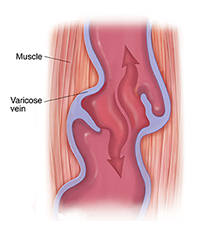
Varicose veins. This is a swollen, twisted vein located close to the skin.
-
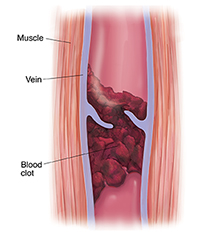
Deep vein thrombosis (DVT). This is a blood clot in one of the deep veins, usually of the legs. The clot can separate from the vein and travel to the lungs (pulmonary embolism or PE). In the lungs, the clot can cut off the flow of blood. These two conditions together are called venous thromboembolism (VTE).
-
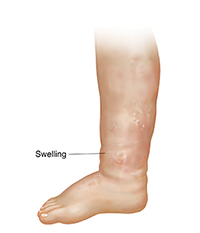
Chronic venous insufficiency. This is a long-term problem with the veins not working well.
Your healthcare provider can give you more information on these conditions and how to prevent and treat them.
When to call your healthcare provider
Call your healthcare provider right away if you have pain, swelling, or redness in one of your legs. These are the symptoms of a blood clot.
Call 911
Call
-
Chest pain
-
Trouble breathing
-
Fast heartbeat
-
Sweating
-
Coughing (may cough up blood)
-
Fainting
These are the symptoms of a blood clot that has traveled to the lungs. This is a medical emergency and may cause death.
Online Medical Reviewer: Anne Fetterman RN BSN
Online Medical Reviewer: Deepak Sudheendra MD
Online Medical Reviewer: Raymond Kent Turley BSN MSN RN
Date Last Reviewed: 12/01/2022
© 2000-2025 The StayWell Company, LLC. All rights reserved. This information is not intended as a substitute for professional medical care. Always follow your healthcare professional's instructions.
Find the right provider to meet your needs
From primary care to specialty services and more.
Find a Doctor
Call for an Appointment
Offering personalized care at more than 20 clinics across three cities and two states.
Call NowRelated Articles
Understanding Vertebral Artery Dissection (VAD)
Vertebral artery dissection is the most common causes of stroke in young and middle-aged adults, but it can occur at any age.
Understanding Veins
The ongoing flow of blood from the heart to the body and back to the heart again is called circulation. Blood vessels carry blood throughout your body. Veins are the vessels that return blood to the heart.
Understanding Circulation
Nonstop flow of blood from the heart to the body and back to the heart again is called circulation. Blood vessels are hollow muscular tubes that carry blood throughout your body, much like pipes circulate water in your home.
Abdominal Angiogram
An angiogram is a type of imaging test. It uses X-rays to look at your blood vessels. An abdominal angiogram looks at the blood vessels in your belly (abdomen). Read on to learn why it's done and what to expect before, during, and after this test.