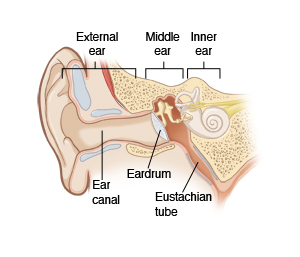
The middle ear is the space behind the eardrum. You have an infection of the middle ear. This can lead to pressure that causes pain and may cause the eardrum to break (rupture). This may cause sudden worse pain. Pus or blood will drain out of the ear canal. Your hearing will also likely be affected.
The infection may be treated with antibiotics. The eardrum usually heals completely on its own. If it does not, further treatment is needed. For this reason, it’s important to have a follow-up exam with your healthcare provider or an ear specialist.
Home care
-
Keep taking prescribed antibiotics until all of the medicine is gone. Do this even if you feel better after the first few days.
-
Take any other medicines as prescribed. Don't take any other medicine without asking your healthcare provider, especially the first time.
-
Keep a clean cotton ball in the ear canal to absorb drainage. Change the cotton often when it becomes soiled with fluid drainage. Don’t let water get into the ear. Don’t put any medicine drops into the ear unless your healthcare provider tells you to do so.
-
Don’t smoke and stay away from secondhand smoke.
Follow-up care
Follow up with your healthcare provider in 2 weeks, or as advised. This is to make sure the infection is getting better, and the eardrum is healing. Also follow up with specialists if advised for a hearing test or exam.
When to get medical advice
Call your healthcare provider if any of the following occur:
-
Fever of 100.4°F (38°C) or higher, or as directed by your healthcare provider
-
Pain that gets worse or doesn’t get better
-
Hearing loss or ringing in the ear that gets worse
Call 911
Call
-
Unusual drowsiness, dizziness, or confusion
-
Convulsions (seizure)
-
A fever and a severe headache, neck pain, or a stiff neck
Online Medical Reviewer: Ashutosh Kacker MD
Online Medical Reviewer: Daphne Pierce-Smith RN MSN
Online Medical Reviewer: John Hanrahan MD
Date Last Reviewed: 01/01/2023
© 2000-2025 The StayWell Company, LLC. All rights reserved. This information is not intended as a substitute for professional medical care. Always follow your healthcare professional's instructions.
Find the right provider to meet your needs
From primary care to specialty services and more.
Find a Doctor
Call for an Appointment
Offering personalized care at more than 20 clinics across three cities and two states.
Call NowRelated Articles
Nosebleed (Adult)
Most nosebleeds happen because of dry air or because of nose-picking. They can occur during a common cold or an allergy attack. Most aren't serious but sometimes you need to see a health care provider.
Sinusitis (No Antibiotics)
Sinusitis is an inflammation of the tissue lining the sinus cavity. Sinus inflammation can occur during a cold. It can also be due to allergies to pollens and other particles in the air.
Uvulitis
Learn about caring for a child or an adult who has uvulitis.
Meniere’s Disease
Meniere's disease is a chronic recurring condition that is due to a problem with the inner ear. It can cause sudden attacks of vertigo, hearing problems, tinnitus, and a feeling of pressure of fullness in the ear.