If your child has hearing loss, hearing aids may be helpful tools. Hearing is important in your child’s development. It helps your child learn to speak, understand language, and communicate with others.
Hearing and your child
When someone has hearing loss, sound still enters the ear. But the sound signals may be weak or distorted by the time they enter the brain. Hearing aids can help by making these signals louder. As a result, signals traveling to the brain are easier to understand. Work with your child’s audiologist to choose the best hearing aids for your child. You will learn how hearing aids are used and how to care for them.
How hearing aids work
Hearing aids have a microphone to pick up sound. They also have a digital processor or amplifier to make sound louder. Amplified sound travels through a tube into a fitted earmold in your child’s ear. With behind-the-ear (BTE) style hearing aids, the microphone and amplifier are kept in a small plastic case that rests behind the ear.
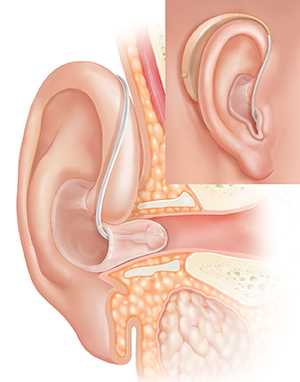
Behind-the-ear hearing aids
Hearing aids come in several styles. BTE hearing aids are most common in younger children. This is because BTE hearing aids are easier to fit for a child’s growing ears than other hearing aids. Hearing aids and plastic earmolds come in many colors, such as skin tones or bright colors. Talk to your child’s audiologist about any questions or concerns you have about BTE hearing aids.
Helping children use hearing aids
Children often can’t put in or take out their hearing aids. Instead, adults must help take care of the hearing aids until children can do it themselves. Care of hearing aids involves cleaning any earwax, changing the batteries, and doing listening checks. Your child’s audiologist will show you how to do all this. Also, keep in mind that the earmolds or entire hearing aids may need to be refit or remade as your child grows. Changes in their hearing will also require hearing aids be adjusted or replaced.
Beware of batteries
Keep small hearing aid batteries away from children. These buttonlike batteries can easily be put in the ears, nose, or mouth. If they become stuck or are swallowed, acid from the battery can leak and burn the inside of the ears, nose, throat, or stomach. Be sure to correctly store and dispose of hearing aid batteries. If a battery is ingested, you can call the National Battery Ingestion Hotline at 800-498-8666 or the Poison Control Center at 800-222-1222 for more information.
Paying for hearing aids
Public or government programs may cover the cost of hearing aids. For instance, Medicaid can give assistance to financially qualified families. If you are worried about how you will pay for your child’s hearing aids, talk to your child’s health care team. They can help point you in the right direction. It's not advisable to buy hearing aids online or through mail order.
To learn more
Online resources you may find helpful include:
Online Medical Reviewer: Ashutosh Kacker MD
Online Medical Reviewer: Rita Sather RN
Online Medical Reviewer: Tara Novick BSN MSN
Date Last Reviewed: 05/01/2025
© 2000-2025 The StayWell Company, LLC. All rights reserved. This information is not intended as a substitute for professional medical care. Always follow your healthcare professional's instructions.
Personalized Pediatric Care
San Juan Health Partners Pediatrics. Dedicated to caring for your children.
Find a Doctor
Call for an Appointment
Offering personalized care at more than 20 clinics across three cities and two states.
Call NowRelated Articles
Tympanoplasty
Tympanoplasty can repair a damaged eardrum, stop infection, and improve hearing. During surgery, you may be given general anesthesia, or local anesthesia with sedation. Tympanoplasty takes about 1 to 3 hours. It may be done along with a mastoidectomy or an ossicular chain reconstruction. The eardrum is at the end of the ear canal.
Tonsil, Adenoid, and Ear Tube Surgery: Anesthesia
Anesthesia is medicine that lets your child sleep during surgery. It is given by a trained specialist. Read on to learn how anesthesia works for surgery for tonsils, adenoids, and ear tubes.
Mastoidectomy
Mastoidectomy can remove infected bone and growths from the middle ear. But it may not always improve your hearing in the affected ear. Read on to learn more.
Treatment for Broken Nose (Nasal Fracture) in Children
Learn details about treating your child's broken nose. Treatment is based on your child’s age, overall health, and the type of injury.