Your child’s outer ear (auricle) is missing or underdeveloped (called microtia). Surgery can be done to build your child an outer ear. The surgery is done in several phases. The exact details of each surgery and the number of surgeries needed depend on the surgeon and on the structures present in your child’s ear. In general, during Phase 3, details of the outer ear are formed. This sheet explains the procedure and what to expect. Often, microtia happens with varying degrees of hearing loss. Your child's hearing loss may be corrected at a later time through different treatments.
Auricular reconstruction is done during three or more surgeries. Phase 3 is often done about
Preparing for surgery
In an age-appropriate manner, explain the surgery to your child. Prepare your child for the surgery as you have been told. Tell the surgeon about all medicines your child takes. This includes over-the-counter medicines. It also includes herbs and other supplements. Your child may need to stop taking some or all of them before surgery. Also, follow any instructions you’re given for preventing your child from eating or drinking before surgery.
The day of surgery
The phase 3 surgery takes about
-
To keep your child from feeling pain during the procedure, they are given general anesthesia. This puts your child in a deep sleep through the procedure.
-
When your child is asleep, an IV (intravenous) line is put into a vein in your child’s arm or hand. This line delivers fluids and medicines. A tube is then passed through your child’s mouth into the windpipe (trachea) to help with breathing during surgery. Special equipment monitors your child’s heart rate, blood pressure, and oxygen levels. The surgeon then begins.
During the procedure
-
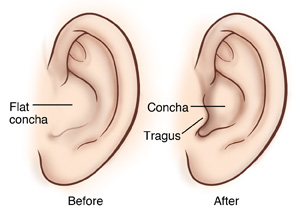
The concha is formed. The concha is the bowl-shaped part of the ear, just outside the ear canal. The skin on the inside of the new ear is carefully removed. This makes a bowl shape.
-
Cartilage and the skin flap are collected. An incision is made on the front or back of the concha of the normal ear (the one without microtia). A small flap of cartilage and skin is removed. The incision is closed with stitches.
-
The tragus is created. The tragus is the small bump of cartilage in front of the opening of the ear canal. The cartilage and skin flap taken from the normal ear are stitched to the skin in front of the newly formed concha. Special dressings are placed on the concha and on both sides of the tragus. The dressings are stitched to the skin. They hold the new parts of the ear in place as the ear heals.
-
One or more tubes (drains) may be placed near incisions. This drains any fluid that builds up in the area after surgery.
Recovering in the hospital
When the surgery is complete, your child will be taken to a room to wake up from the anesthesia. You may be able to see your child at this time. Your child will be watched as they rest. Pain medicine can be given if needed. If your child needs to stay overnight, you and your child will be taken to a hospital room. You will be told when you can take your child home.
Recovering at home
Once home, follow any instructions you are given for caring for your child. During your child’s recovery:
-
Give prescribed medicines as instructed. Even if your child doesn’t complain of pain, give the medicine on time. Don't wait for the pain to get bad. (This makes the pain harder to control.)
-
Do your best to prevent your child from touching the ear. Don’t let siblings or other children touch your child’s ear or play roughly around your child as they heal.
-
If your child is sent home with a drain in an incision, follow the instructions you were given for how to care for it.
When to call the healthcare provider
Be sure you have a contact number for your child’s surgeon. After you get home, call if your child has any of the following:
-
Fever of
100.4 ° F (38 ° C) or higher, or as directed by your child's surgeon -
Bleeding or a large amount of drainage from an incision
-
Symptoms of infection at an incision site, such as increased redness or swelling, warmth, worsening pain, or foul-smelling drainage
-
Any injury to the ear
Follow-up
Take your child for scheduled follow-up visits. If appropriate for your child's age, encourage them to write down questions or concerns about the procedure. Make time during the visit for your child's questions or concerns to be discussed. During these visits, the surgeon will check to be sure the ear is healing correctly. At this time, you and the surgeon can discuss if any further surgeries are needed to complete the ear.
Risks and complications
All procedures have risks. The risks of this procedure include:
-
Bleeding
-
Infection
-
Risks of anesthesia. You will discuss these with the anesthesiologist.
-
Dislike of how the ear looks after surgery
-
Cartilage wearing through the skin (extrusion)
Online Medical Reviewer: Daphne Pierce-Smith RN MSN
Online Medical Reviewer: David Lickstein MD
Online Medical Reviewer: Pat F Bass MD MPH
Date Last Reviewed: 12/01/2022
© 2000-2025 The StayWell Company, LLC. All rights reserved. This information is not intended as a substitute for professional medical care. Always follow your healthcare professional's instructions.
Personalized Pediatric Care
San Juan Health Partners Pediatrics. Dedicated to caring for your children.
Find a Doctor
Call for an Appointment
Offering personalized care at more than 20 clinics across three cities and two states.
Call NowRelated Articles
Tonsil, Adenoid, and Ear Tube Surgery: Preparing for Surgery
Here are some things that you'll need to do before your child's surgery.
Stapes Surgery
Stapes surgery can improve conductive hearing. Learn more about this surgery here.
Septoplasty for Children
Septoplasty is surgery to fix a septum. The septum is the wall that divides your child's nose into two sides. It is made of soft cartilage and bone and is covered with a mucous membrane. A deviated septum is when the septum is not in the middle.
Treating Dysarthria
Dysarthria happens when the part of the brain that controls speech production is damaged. There may be abnormalities with the speech and tone. Working with a speech therapist can help. Read on to learn more.