An audiometric test measures how well you hear. It's quick and painless. The Occupational Safety and Health Administration (OSHA) and your employer may require this test each year. Follow through with it. You can't "fail" a hearing test. The test results just help your employer know whether more hearing protection is required.
What to expect
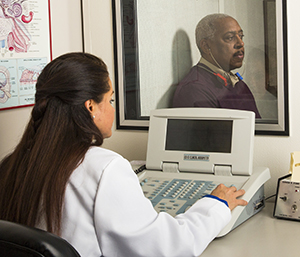
You may be tested in a clinic or in a mobile testing van. The test lasts only a few minutes and is easy to do. An audiologist (hearing specialist) will give you headphones and seat you in a soundproof room. The audiologist will then play tones at many pitches and volumes. When you hear the tones, you press a button or raise your hand.
Your test results
The test result is a graph called an audiogram. It shows how well you hear. The result of your first hearing test will be your baseline. Future tests will be compared to your baseline to see whether your hearing has changed. If your test shows a change from your baseline, you may be tested more often. It could mean that you and your employer need to change the type of protection you usually wear.
Online Medical Reviewer: Ashutosh Kacker MD
Online Medical Reviewer: Daphne Pierce-Smith RN MSN CCRC
Online Medical Reviewer: Marianne Fraser MSN RN
Date Last Reviewed: 10/01/2024
© 2000-2025 The StayWell Company, LLC. All rights reserved. This information is not intended as a substitute for professional medical care. Always follow your healthcare professional's instructions.
Find the right provider to meet your needs
From primary care to specialty services and more.
Find a Doctor
Call for an Appointment
Offering personalized care at more than 20 clinics across three cities and two states.
Call NowRelated Articles
How Hearing Aids Can Help You
Many people find that a correctly selected and fitted hearing aid helps them hear much better. Here's what you need to know.
Hearing Protection: Measuring Sound
At the workplace, your employer measures noise with sound level meters and dosimeters. If the average noise exposure over an 8-hour work shift is 85 dB or higher, you need protection. OSHA requires your employer to have a hearing conservation program.
Dysphagia Diet: Managing Drinks
Dysphagia is trouble swallowing normally. A dysphagia diet is a way of eating and drinking that is safer for a person who has trouble swallowing. It helps to prevent aspiration. On a dysphagia diet, only certain kinds of liquids are safe to drink.
Treating Ménière’s Disease: Eating a Low-Salt Diet
Salt contains sodium, which makes your body hold excess fluid. Because Meniere's disease is caused by fluid buildup in the inner ear, eating less sodium may help relieve your symptoms.