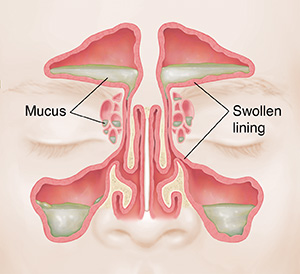
Mucus helps keep your sinuses clean. But mucus may build up in the sinuses because of colds, allergies, or blockages. These things get in the way of the natural drainage of mucus. This may lead to sinusitis. Sinusitis means sinus inflammation and infection.
-
Acute sinusitis may come on suddenly. It often happens right after an upper respiratory infection, such as a cold. Viruses cause most acute sinus infections. But bacteria may also be the cause.
-
Chronic sinusitis is ongoing swelling of the sinus lining. Health experts don't fully understand what causes this.
Colds and other infections
A cold or flu may cause your sinus and nasal linings to swell. Sinus openings can become blocked. This causes mucus to back up. This backed-up mucus becomes an ideal place for bacteria to grow. Thick, yellow, or discolored mucus is one sign of infection.
Allergic reactions
You may be sensitive to certain substances. This causes the release of histamine in the body. Histamine makes your sinus and nasal linings swell. Long-term swelling clogs your sinuses. It prevents the tiny hairs (cilia) in the nasal lining from sweeping away mucus. Allergy symptoms can continue over time. But they’re less severe than with colds.
Blockages
-
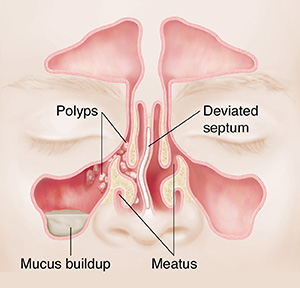
A polyp is a sac of swollen tissue. It can be the result of an allergy or infection. It may block the opening where most of your sinuses drain (middle meatus). It may even grow large enough to block your nose.
-
A deviated septum is when the thin wall inside your nose is pushed to one side. It's often the result of injury. This can block your middle meatus.
People with chronic nasal problems or allergies are more likely to get acute sinusitis. Sinusitis is also more common if you have a weakened immune system, such as with HIV. You're also more likely to get sinusitis if you have cystic fibrosis or another condition that causes your body to make extra mucus.
Online Medical Reviewer: Ashutosh Kacker MD
Online Medical Reviewer: Rita Sather RN
Online Medical Reviewer: Tara Novick BSN MSN
Date Last Reviewed: 03/01/2024
© 2000-2025 The StayWell Company, LLC. All rights reserved. This information is not intended as a substitute for professional medical care. Always follow your healthcare professional's instructions.
Find the right provider to meet your needs
From primary care to specialty services and more.
Find a Doctor
Call for an Appointment
Offering personalized care at more than 20 clinics across three cities and two states.
Call NowRelated Articles
Inner Ear Problems: Causes of Dizziness (Vertigo)
The various causes of vertigo, such as an infection, are detailed here.
Ears and airplane travel, earwax, and ear cleaning
Detailed information on ears and airplane travel, ear wax, and ear cleaning.
The Middle Ear
The middle ear is an air-filled chamber that lies behind the eardrum. Pressure in the middle ear changes to match air pressure outside of the eardrum. When inside and outside pressures are balanced, the eardrum is flexible and normal hearing is more likely. Problems happen when air pressure in the middle ear drops. This is often due to a block in the eustachian (u-STA-shun) tube, the narrow channel connecting the ear with the back of the throat.
Cochlear Implant Surgery
A cochlear implant is a device that helps reverse nerve-related hearing loss. It can treat hearing loss that will not respond to hearing aids. During cochlear implant surgery, the device is implanted into the inner ear (cochlea). A few weeks after surgery, the device is turned on and hearing is restored.