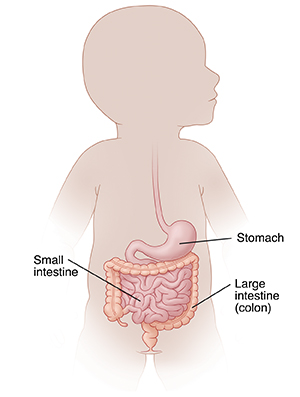
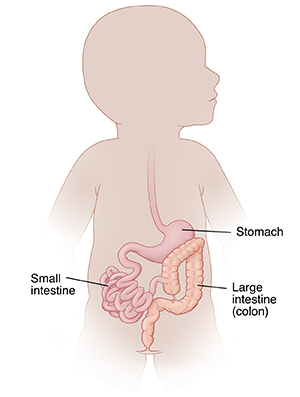
While a baby is still in the womb, their bowels (intestines) form. As they form, they move into their normal position in the belly (abdomen). Intestinal malrotation happens when the intestines don’t form in the right position. The intestines may bend the wrong way. Or, parts of the intestine may end up in the wrong part of the abdomen. Bands of tissue called Ladd bands can grow between the intestines and body wall. These secure the intestines in the wrong place. Ladd bands can also block part of the intestine and cause digestive problems.
Why is intestinal malrotation a problem?
Intestinal malrotation most often isn’t a problem by itself. But it makes a child more likely to have a twisted intestine. This is called a volvulus. A volvulus can be very dangerous. EYou child will need emergency treatment. This is why intestinal malrotation needs to be treated, even if your child has no symptoms.
What are the symptoms of intestinal malrotation?
In many cases, the condition causes no symptoms. If symptoms do occur, they often happen during a child’s first year and signal intestinal blockage. These symptoms can include:
-
Vomiting that may contain green bile
-
Mildly bloated abdomen
-
In severe cases, vomiting of blood and blood from the rectum
-
Fever
-
Belly (abdominal) pain
How is intestinal malrotation diagnosed?
In some cases, the problem may be found during a test for another health problem. In other cases, the healthcare provider will ask about your child’s symptoms and health history. They will give your child a physical exam. Your child may have tests such as:
-
Abdominal ultrasound. Sound waves are used to create an image of the inside of the abdomen.
-
Upper GI (gastrointestinal) series. X-rays are taken of the upper digestive tract from the mouth to the small intestines. Your child swallows a chalky fluid with barium. This liquid coats the insides of the upper digestive tract. The barium causes it to show up on an X-ray.
-
Barium enema. Barium is inserted through the anus into the rectum. It coats the inside of the lower digestive organs so they show up on an X-ray.
-
CT scan. Your child may be given a dye to drink and IV (intravenous) dye before several abdominal X-rays are taken from different angles.
How is intestinal malrotation treated?
-
For intestinal malrotation, surgery will be scheduled. During surgery, Ladd bands are cut. The intestines are then moved to where they will be least likely to twist. If the child still has their appendix, it will be removed during the surgery.
-
For intestinal malrotation with a volvulus, emergency surgery is done. The intestines are carefully untwisted. If a part of intestine has died due to lack of blood flow, this part must be removed. The healthy ends of the intestines are then reattached. If a long length of intestine is removed, a small opening (stoma) may need to be made in the child’s abdomen. This provides a new way for waste to leave the body. If your child needs a stoma, the healthcare provider will tell you more.
When to call the healthcare provider
Call your child’s healthcare provider right away if your child has signs of a volvulus, such as:
-
Stomach pain and swelling
-
Nausea or vomiting
-
Inability to pass stool
-
Bloody stools
Featured in
Online Medical Reviewer: Jen Lehrer MD
Online Medical Reviewer: L Renee Watson MSN RN
Online Medical Reviewer: Rita Sather RN
Date Last Reviewed: 05/01/2022
© 2000-2025 The StayWell Company, LLC. All rights reserved. This information is not intended as a substitute for professional medical care. Always follow your healthcare professional's instructions.
Personalized Pediatric Care
San Juan Health Partners Pediatrics. Dedicated to caring for your children.
Find a Doctor
Call for an Appointment
Offering personalized care at more than 20 clinics across three cities and two states.
Call NowRelated Articles
Hernias in Children
A hernia occurs when a section of bowel pushes out through a weakness in the muscle. The hernia looks like a bulge under the skin. In baby boys, a bulge in the scrotum is the most common type of hernia and is the result of a persistent canal between the scrotum and abdomen that normally closes when a fetus is developing. A hernia can move back into the abdomen through the passage. So you may not see the bulge all the time. You may see it most when your baby is straining (such as during crying, feeding, or a bowel movement).
When Your Child Has Biliary Atresia
The liver makes a substance called bile. It helps with digestion of food and helps carry waste out of the liver. Bile drains out of the liver through tubes called bile ducts. It drains through these ducts into the duodenum (the first part of the small intestine). If a child has biliary atresia, it means that some or all bile ducts aren't formed correctly, are damaged, or are missing. As a result, bile can't drain from the liver as it should.
E. coli Infection in Children
E. coli is a common bacteria found in people's and animals' intestines. It's also found in the environment and in food. Certain types of E. coli are harmful and can cause severe illness. Learn how E. coli affects children and how it's treated.
Salmonella Gastroenteritis (Baby/Toddler)
Children can get salmonella from eating certain foods or water that has come into contact with the feces of an infected animal or person. Here's how to care for your child at home and what to watch for.