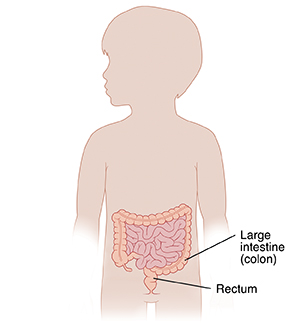
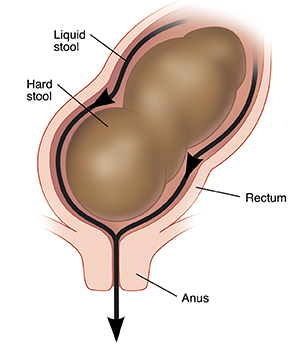
Your child has uncontrolled leakage of poop (stool) from the opening where poop leaves the body (anus). This is called encopresis. The leakage is caused by the backup of dry, hard poop (constipation). Hard poop piles up at the end of the rectum. This is where poop is stored before leaving through the anus. The lower colon and rectum may become stretched out. Your child may not even feel the need to poop. In time, liquid poop leaks around the blockage and out through the anus. This leakage often happens without your child’s knowing it. Encopresis can be treated to stop this occurring.
What are the symptoms of encopresis?
-
Liquid poop leakage onto the underwear
-
Poop leakage with the passing of gas
-
Pain around or under the belly button
-
No feeling of having to pass poop before leakage happens
-
Belly swelling or bloating
What causes encopresis?
Encopresis is caused by constipation. Some causes of constipation that may lead to encopresis include:
-
Child holding back poop. This may happen for several reasons. These include a past painful poop, emotional stress, resistance to toilet training, or another reason.
-
Hirschsprung’s disease. A birth defect in which nerves in the large intestine (colon) are missing.
-
Anteriorly placed anus. The anus is closer to the vagina or penis than normal.
How is encopresis diagnosed?
The healthcare provider will ask about your child’s symptoms. They'll give your child a physical exam. Your child may have blood tests to check for other problems.
How is encopresis treated?
-
Your child may be prescribed a stool softener. These will help your child have normal poops.
-
The healthcare provider may advise changes in diet. This may include adding more fiber. Fiber helps poop retain water.
-
Your child may need to drink more water and get regular exercise.
-
Your child may have bowel retraining. This process can help your child have normal poop (bowel movements). Your child sits on the toilet for a short time after meals. This helps the body reconnect eating with having bowel movements. Your child's provider will talk with you about the best way to start bowel retraining. Be patient. It can take 4 to 6 months or longer before encopresis goes away.
-
Your child and you may be asked to keep a toilet diary. And to start a bowel routine. This will include having set times to sit on the toilet. The provider may advise giving your child rewards for following the routine. These may include stickers.
Featured in
Online Medical Reviewer: Amy Finke RN BSN
Online Medical Reviewer: L Renee Watson MSN RN
Online Medical Reviewer: Liora C Adler MD
Date Last Reviewed: 06/01/2022
© 2000-2025 The StayWell Company, LLC. All rights reserved. This information is not intended as a substitute for professional medical care. Always follow your healthcare professional's instructions.
Personalized Pediatric Care
San Juan Health Partners Pediatrics. Dedicated to caring for your children.
Find a Doctor
Call for an Appointment
Offering personalized care at more than 20 clinics across three cities and two states.
Call NowRelated Articles
Hernias in Children
A hernia occurs when a section of bowel pushes out through a weakness in the muscle. The hernia looks like a bulge under the skin. In baby boys, a bulge in the scrotum is the most common type of hernia and is the result of a persistent canal between the scrotum and abdomen that normally closes when a fetus is developing. A hernia can move back into the abdomen through the passage. So you may not see the bulge all the time. You may see it most when your baby is straining (such as during crying, feeding, or a bowel movement).
Understanding H. Pylori and Ulcers in Your Child
Helicobacter pylori (H. pylori) is a common bacteria. It is a cause of ulcers (sores). It weakens the mucous layer that coats the inside of the stomach and duodenum (first part of the small intestine). This allows stomach acid to flow through the weakened layer and burn the tissue of the stomach wall below.
E. coli Infection in Children
E. coli is a common bacteria found in people's and animals' intestines. It's also found in the environment and in food. Certain types of E. coli are harmful and can cause severe illness. Learn how E. coli affects children and how it's treated.
Dysphagia (Child)
Dysphagia is trouble swallowing. This means your child may choke when eating or drinking.