Your esophagus is the tube that carries food from your mouth to your stomach. It plays an important role in digestion. Sometimes a person can tear the tissue of the lower esophagus and the top of the stomach. The tissue can then start to bleed. This is called a Mallory-Weiss tear.
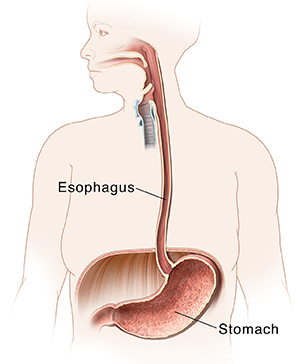
Causes and symptoms of a Mallory-Weiss tear
The most common cause of a tear is violent coughing or vomiting. Increased pressure in your belly (abdomen) from a hiatal hernia or childbirth can also lead to a tear. Seizures may cause a tear. So can alcoholism that leads to severe vomiting. Increasing age also raises the risk for a Mallory-Weiss tear.
A tear can cause symptoms such as:
-
Vomit that is bright red or looks like coffee grounds.
-
Stools that are black or sticky like tar.
-
Weakness, dizziness, faintness, or shortness of breath.
-
Diarrhea.
-
Belly pain that sometimes spreads to the back.
If the bleeding isn't treated, it can continue for a long time. This can cause anemia, severe tiredness (fatigue), shortness of breath, and even death.
Diagnosing and treating a Mallory-Weiss tear
If you have symptoms, you may have your stool tested to look for blood. You may also have an endoscopy. This is a procedure to look at your esophagus. It uses a tool called an endoscope. This is a thin, flexible tube with a camera and light at the end. After giving you some light sedation, the scope is put through your mouth and down into your esophagus. This lets your health care provider look at the inside of your esophagus.
In most cases, a Mallory-Weiss tear will stop bleeding and heal on its own. But some people will need treatment. If needed, your provider will treat your tear through the endoscope. You may have an injection to make the bleeding stop. Or you may be given a heat treatment to close the wound. In some cases, a tiny clip may be used to close the tear. Depending on how much blood is lost, you may need a blood transfusion. After treatment, you'll likely have to take an acid blocker medicine for a couple of weeks to help with healing.
Call 911
In rare cases, a Mallory-Weiss tear can lead to severe internal bleeding. This is a medical emergency. Call
-
Have a rapid, weak pulse.
-
Vomit large amounts of blood.
-
Have a blue tint to your lips or fingernails.
-
Have very little urine.
-
Have pale skin that’s cool and moist to the touch.
-
Are confused.
-
Have shallow breathing.
Author: Wheeler, Brooke
Online Medical Reviewer: Jen Lehrer MD
Online Medical Reviewer: Melinda Murray Ratini DO
Online Medical Reviewer: Rita Sather RN
Date Last Reviewed: 02/01/2025
© 2000-2025 The StayWell Company, LLC. All rights reserved. This information is not intended as a substitute for professional medical care. Always follow your healthcare professional's instructions.
Find the right provider to meet your needs
From primary care to specialty services and more.
Find a Doctor
Call for an Appointment
Offering personalized care at more than 20 clinics across three cities and two states.
Call NowRelated Articles
Chronic Liver Disease/Cirrhosis
Cirrhosis is when scar tissue replaces healthy liver tissue. This stops the liver from working normally.
Understanding Intestinal Obstruction
An intestinal obstruction means that the small or large intestine is blocked at one or more spots. This prevents air, food, stool, and fluid from passing normally through the digestive system.
Mesenteric Adenitis
Mesenteric adenitis is swelling of the lymph nodes in the belly. The problem is often caused by an infection or inflammatory condition of the intestines. Here's how to care for yourself at home as you heal.
Crohn's Disease
Crohn’s disease is part of a group of diseases known as inflammatory bowel disease or IBD.