Total parenteral nutrition (TPN) is a way for your child to get correct nutrition. This is done using a small, soft tube called a catheter . The catheter is put into a vein. This allows liquid nutrition to be put into your child’s blood vessels.
Why is TPN needed?
TPN is used when your child’s digestive tract can’t digest food. Or when your child can’t eat enough food to meet his or her nutritional needs. The catheter is put into the vein in the hospital. Then you can give TPN to your child at home. A home care nurse can teach you how. You’ll also learn how to clean and care for the catheter site.
Types of TPN lines
There are 2 main types of TPN lines used to give nutrition through the catheter:
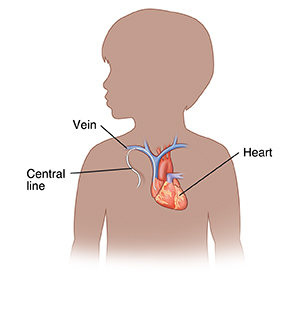
Central line. This kind of line is often used for babies and very young children. The catheter is placed into a vein in the neck or chest. This allows nutrients to be delivered close to the large blood vessels of the heart. The catheter has openings (ports) to give nutrition and medicines as needed.
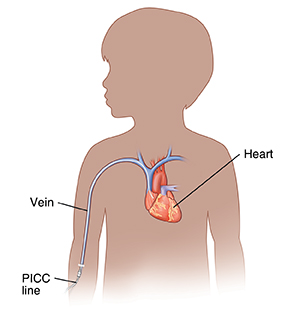
Peripherally inserted central catheter (PICC) line. This type of line is often placed into a vein in your child’s arm. The line is gently threaded through the vein up to the heart.
When to call the healthcare provider
Call the healthcare provider right away if your child has any of these:
-
Tubing that splits or leaks, or that comes out part way or all the way
-
Fluid leaking from the catheter insertion site
-
Fever over
100.4 °F (38 °C) or higher, or as directed by the provider -
Trouble breathing
-
Vomiting
-
Skin or whites of eyes that turn yellow (jaundice)
-
Bulging of skin around catheter site
-
Bleeding around catheter site
-
Skin pulling away from catheter site
-
Pain, redness, swelling, or warmth at catheter site
-
Swelling of the hand, arm, back, or torso
-
Blocked tubing
Featured in
Online Medical Reviewer: Amy Finke RN BSN
Online Medical Reviewer: Jen Lehrer MD
Online Medical Reviewer: L Renee Watson MSN RN
Date Last Reviewed: 06/01/2022
© 2000-2025 The StayWell Company, LLC. All rights reserved. This information is not intended as a substitute for professional medical care. Always follow your healthcare professional's instructions.
Personalized Pediatric Care
San Juan Health Partners Pediatrics. Dedicated to caring for your children.
Find a Doctor
Call for an Appointment
Offering personalized care at more than 20 clinics across three cities and two states.
Call NowRelated Articles
Your Child’s Bowel Surgery
This bowel operation may involve the small intestine, large intestine (colon), or rectum. This sheet tells you how to prepare for the surgery and what to expect during it. It also tells you how to help your child recover afterward.
Hernia Surgery: Umbilical Hernia Repair (Child)
Childhood hernias can be safely fixed using outpatient (same-day) surgery.
When Your Child Needs a Nasogastric (NG) Tube
If your child is having trouble swallowing food or liquids safely, the health care provider may suggest tube feeding. Tube feeding is often done with a nasogastric (NG) tube.
Your Child's Nasogastric Tube: Pump Feeding
Detailed information on how to feed your child using a nasogastric (NG) feeding tube.