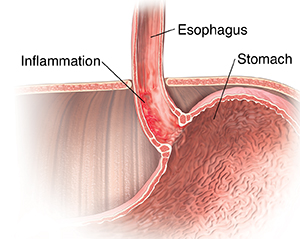
The esophagus is the swallowing tube that joins the mouth to the stomach. In people with GERD (gastroesophageal reflux disease), stomach acid flows back into the esophagus. Over many years, stomach acid can hurt the esophagus.
Barrett esophagus is when the damaged cells in the esophagus lining change to a different type of cell. These changed cells help protect the esophagus from stomach acid. But, over time, they're more likely than normal lining cells to become cancer. The acid reflux medicines used to stop heartburn do not help these cells heal or change back to normal tissue.
Radiofrequency ablation (RFA) is a procedure that uses an electrical current to kill the changed or damaged cells. It can be used to help prevent or treat cancer of the esophagus.
Why RFA for Barrett esophagus is done
RFA is most often used for people who have precancer changes in the cells lining the esophagus. It destroys the changed or abnormal cells so they can't grow into cancer. Normal lining cells then grow back to replace the damaged lining of the esophagus.
How RFA for Barrett esophagus is done
RFA is most often done as an outpatient. This means you go home the same day. During the procedure:
-
You are given medicine (anesthesia) to keep you pain-free and make you sleep during the treatment.
-
The healthcare provider puts a thin, lighted tube (called an endoscope) into your mouth. The tube is passed down your throat into your esophagus. A camera in the tube sends live video from inside your esophagus to a computer screen.
-
A balloon that holds many tiny electrodes is put through the tube. It's moved down into the area of changed cells. It's inflated so that it touches the sides of the esophagus. Then electricity is sent to the electrodes. This heats up the esophagus lining, killing the cells.
-
When the procedure is done, the provider takes out the balloon and the endoscope.
After RFA, you might be given medicines for pain and to reduce acid and coat the treated area while it heals. Your provider might talk with you about doing endoscopies every few months to watch the treated area. If needed, RFA can be repeated to be sure that all the changed cells are gone.
Risks of RFA for Barrett esophagus
Risks and side effects aren't common, but can include:
-
Chest discomfort or pain for a few days
-
Sore throat or trouble swallowing for a few days
-
Narrowing of the esophagus (stricture)
-
Irritation of or hole (perforation) in the esophagus
-
Bleeding in the treated area
-
Problems linked to the anesthesia
Author: Michels, Karen
Online Medical Reviewer: Kimberly Stump-Sutliff RN MSN AOCNS
Online Medical Reviewer: L Renee Watson MSN RN
Online Medical Reviewer: Todd Gersten MD
Date Last Reviewed: 12/01/2024
© 2000-2025 The StayWell Company, LLC. All rights reserved. This information is not intended as a substitute for professional medical care. Always follow your healthcare professional's instructions.
Find the right provider to meet your needs
From primary care to specialty services and more.
Find a Doctor
Call for an Appointment
Offering personalized care at more than 20 clinics across three cities and two states.
Call NowRelated Articles
Types of Colon Resections
In colon resection, a part of the colon is taken out (resected) during surgery. The most common types of colorectal resection are listed here.
Having Bowel Surgery: Continent Ileostomy
This surgery is done to treat diseases of the digestive tract. It removes all of the large intestine. During the surgery, an opening (stoma) is made in your belly. When healed, waste collects in a pouch inside your body. It's then drained through a thin tube (catheter).
Having Laparoscopic Colon Surgery
After discussing your colon problem, you and your healthcare provider may decide that laparoscopic treatment is right for you. How well you get ready for the surgery can affect its success. Make sure you understand all instructions your provider gives you.
Having Rectal Surgery
Read on for details about rectal surgery, including what to expect before, during, and after the procedure.