Do you have to clear your throat or cough often? Are you hoarse? Do you have trouble swallowing, or have heartburn, or pain in your throat? If you have these or other throat symptoms, you may have acid reflux. This occurs when stomach acid flows back up and irritates your throat.
Why you have throat symptoms
There are muscles (esophageal sphincters) at both ends of the tube that carries food to your stomach (the esophagus). These muscles relax to let food pass. Then they tighten to keep stomach acid down. When the lower esophageal sphincter (LES) doesn’t tighten enough, acid can flow back (reflux) from your stomach into your esophagus. This may cause heartburn. In some cases, the upper esophageal sphincter (UES) also doesn’t work well. Then acid can travel higher and enter your throat (pharynx). In many cases, this causes throat symptoms.
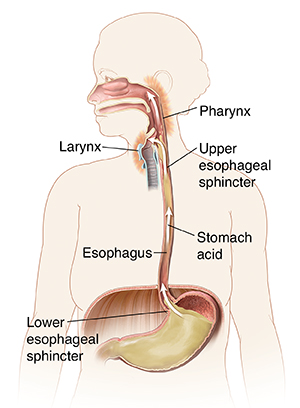
Common throat symptoms
-
Need to clear your throat often
-
Feeling like you’re choking
-
Long-term (chronic) cough
-
Hoarseness
-
Trouble swallowing
-
Feel like you have a lump in your throat
-
Sour or acid taste
-
Sore throat that keeps coming back
Online Medical Reviewer: Jen Lehrer MD
Online Medical Reviewer: John Hanrahan MD
Online Medical Reviewer: L Renee Watson MSN RN
Date Last Reviewed: 01/01/2024
© 2000-2025 The StayWell Company, LLC. All rights reserved. This information is not intended as a substitute for professional medical care. Always follow your healthcare professional's instructions.
Find the right provider to meet your needs
From primary care to specialty services and more.
Find a Doctor
Call for an Appointment
Offering personalized care at more than 20 clinics across three cities and two states.
Call NowRelated Articles
Rectal Prolapse
Rectal prolapse means the rectum has fallen out of position. In many cases, rectal tissue sags out of the anus. Here's what you need to know.
When You Have Gastrointestinal (GI) Bleeding
Blood in your vomit or stool can be a sign of gastrointestinal (GI) bleeding. GI bleeding can be scary. But the cause may not be serious. Here's a look at the possible causes of GI bleeding, and the types of tests you can expect.
Ileostomy: Changing Your Pouch
Read on for step-by-step directions on how to change your ileostomy pouch.
Feeding Tube Replacement
Your feeding tube has been replaced. Unless advised otherwise, you may resume your usual feeding schedule. Feeding tubes are usually replaced every 6 to 12 months.