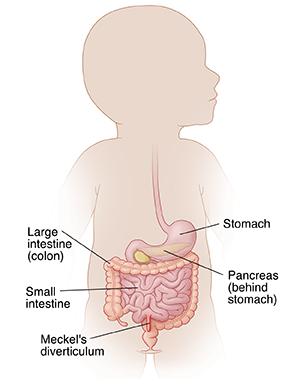
A Meckel scan is an imaging test used to detect a Meckel diverticulum. This is a small, abnormal pocket in the wall of a child’s small intestine.
What is a Meckel diverticulum?
When a baby is growing in the womb, its gastrointestinal tract is forming. A small duct forms off an area of what will become the small intestine. The baby’s body gets rid of this duct very early when it's growing in the womb, but in some cases, it doesn’t. This results in a small pouch or pocket off part of the small intestine. This is called a Meckel diverticulum. It's not common. It often has the same tissue as that of the stomach or pancreas, which then may cause bleeding.
Why might I need a Meckel scan done?
Many children with a Meckel diverticulum never have any symptoms from it. Your child may need a Meckel scan if they have symptoms like pain in the belly or blood in their stool. The healthcare provider may advise a Meckel scan if other tests haven’t found the cause of your child’s symptoms.
How is a Meckel scan done?
A Meckel scan can help find this abnormal tissue. During the scan, a substance called technetium-99m is given through an IV (intravenous) line into a vein. This substance has a tiny amount of radioactive material in it. Stomach tissue absorbs most of this substance. A special camera called a gamma camera can detect the radiation. It takes a series of pictures of your child’s abdomen. The camera will show if there is a Meckel diverticulum in your child’s small intestine.
What are the risks of a Meckel scan?
All procedures have some risks. The risks of a Meckel scan are minimal and may include a small amount of bleeding where the IV was inserted.
A Meckel scan does use radiation. But it uses only a tiny dose, about the same as a chest X-ray. In high doses, radiation is dangerous and raises the risk for cancer. The amount of radiation from a single Meckel scan is so small that it likely does not really increase your child’s risk for cancer. Your child’s healthcare provider will advise a Meckel scan only if the risks of not getting a scan are greater than any possible risks from radiation. Talk with your healthcare provider if you have any concerns.
Featured in
Online Medical Reviewer: Kenny Turley PA-C
Online Medical Reviewer: Louise Cunningham RN BSN
Online Medical Reviewer: Neil Grossman MD
Date Last Reviewed: 12/01/2022
© 2000-2025 The StayWell Company, LLC. All rights reserved. This information is not intended as a substitute for professional medical care. Always follow your healthcare professional's instructions.
Personalized Pediatric Care
San Juan Health Partners Pediatrics. Dedicated to caring for your children.
Find a Doctor
Call for an Appointment
Offering personalized care at more than 20 clinics across three cities and two states.
Call NowRelated Articles
When Your Child Needs an Upper Endoscopy
An upper endoscopy is a test that shows the inside of the upper gastrointestinal (GI) tract. This includes the esophagus, stomach, and the first part of the small intestine (duodenum). The healthcare provider can do a biopsy, check for problems, or remove objects. The test normally takes about 15 to 20 minutes.
Having a Meckel’s Scan (Child)
A Meckel's scan is an imaging test used to detect a Meckel's diverticulum. This is a small, abnormal pocket in the wall of a child's small intestine.
When Your Child Needs an Upper GI Series
An upper GI series is an X-ray exam of the upper digestive tract. Here's what you should know when your child needs this exam.
When Your Child Needs a Percutaneous Liver Biopsy
A liver biopsy is a quick test that helps see how healthy your child's liver is. During a percutaneous liver biopsy, a needle is inserted through the skin and into the liver. A small sample of liver tissue is then taken. The tissue is sent to the lab to be studied.