The liver is in the upper right part of the belly (abdomen.) Most of it is protected by the ribs. The liver is a vital organ that has many jobs. The liver:
-
Makes bile, a substance that helps the body digest fat.
-
Works with the stomach and intestines to digest food.
-
Makes proteins and blood-clotting factors that the body needs.
-
Manages sugar (glucose) levels in the blood, and stores extra sugar.
-
Stores vitamins and minerals.
-
Removes poisonous (toxic) substances from the blood.
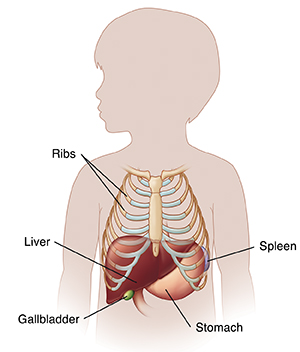
Learning the anatomy
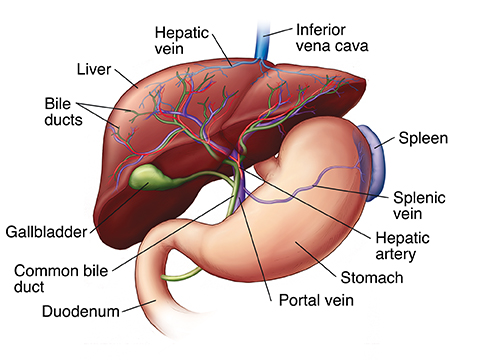
The parts of the liver and nearby organs include:
-
Gallbladder. This is an organ that stores bile.
-
Bile ducts. These are tubes between the liver and small intestine. Bile drains into them from the liver.
-
Common bile duct. The duct from the liver (hepatic duct) and the duct from the gallbladder (cystic duct) meet to form the common bile duct. The common bile duct carries bile to the duodenum.
-
Duodenum. This is the first part of the small intestine. When bile leaves the liver and gallbladder, it flows through the bile ducts into the duodenum. Here, bile starts mixing with food to help digestion.
-
Biliary tree. This is a network of tubes that carry bile out of the liver and into the duodenum.
-
Spleen. This is an organ that filters blood. It’s also part of the immune system and helps the body fight infection.
-
Portal vein. This is a blood vessel that carries nutrient-rich blood from the digestive tract and spleen into the liver.
-
Splenic vein. This is a blood vessel that carries blood from the spleen to the portal vein.
-
Hepatic veins. These are blood vessels that carry blood out of the liver to the inferior vena cava.
-
Inferior vena cava. This is a large vein that carries blood from the liver, legs, and kidneys to the heart.
-
Hepatic artery. This is a blood vessel that carries blood into the liver from the heart.
How blood is processed by the liver
All the blood that flows from the intestines, stomach, and spleen is filtered through the liver. The blood flows into the liver through the portal vein. It filters through the liver in a system of smaller and smaller veins. As blood passes over liver cells, these cells process nutrients in the blood. This makes products, such as proteins and sugars, that can be used by the body. Blood is then carried out of the liver through the hepatic vein to the heart.
Featured in
Online Medical Reviewer: Daphne Pierce-Smith RN MSN
Online Medical Reviewer: Marianne Fraser MSN RN
Date Last Reviewed: 03/01/2025
© 2000-2025 The StayWell Company, LLC. All rights reserved. This information is not intended as a substitute for professional medical care. Always follow your healthcare professional's instructions.
Personalized Pediatric Care
San Juan Health Partners Pediatrics. Dedicated to caring for your children.
Find a Doctor
Call for an Appointment
Offering personalized care at more than 20 clinics across three cities and two states.
Call NowRelated Articles
When Your Child Needs a Stoma
If your child has a problem affecting the intestines, they may need a stoma (opening). A stoma provides a new way for stool and mucus to leave the body. During surgery to create a stoma, the colon or sometimes part of the small intestine is removed or disconnected. The end of the intestine is then rerouted through the abdominal wall. Waste leaves the body through the stoma and empties into a bag. It's important to help care for your child's stoma at home. You can help your child adjust to having a stoma.
Cecostomy for Children
Cecostomy is surgery to clear a child's bowels of feces when other treatment has not worked. It is used for children with fecal incontinence caused by major health problems.
Your Child's Nasogastric Tube: Replacing the Tube
Use this sheet to help you remember how to place your child's NG tube when you get home.
When Your Child Has a Gastric or Duodenal Ulcer
An ulcer is a breakdown of tissue on the inside of the stomach or small intestine. This causes a sore to form. Learn more about what to do when your child has an ulcer in the stomach (gastric ulcer) or in the first part of the small intestine (duodenal ulcer).