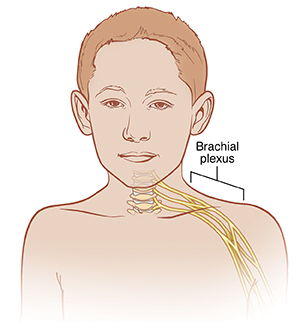
Your child has been diagnosed with a condition called a "stinger" or a "burner." This is shooting pain that travels down the neck to the arm. It happens when a group of nerves in the neck and shoulder has been injured. A stinger is painful but not usually serious. There are steps you and your child can take to relieve the pain.
What causes a stinger?
Stingers occur when the head is forcefully pushed sideways and down. This bends the neck and pinches the surrounding nerves in the neck and shoulder. Athletes are most likely to get stingers. This includes football players and wrestlers. This is due to some of the movements in these sports. They include moves such as tackling in football and take-down maneuvers in wrestling.
What are the symptoms of a stinger?
Stingers are felt right after the injury. Symptoms include:
-
Shooting pain from the neck down the arm. It may feel like a burning or electric shock sensation.
-
Numbness or tingling in the arm and shoulder
-
Muscle weakness in the arm and shoulder (temporary)
It’s common for symptoms to last for seconds or minutes. If pain doesn’t go away after this time, the problem may be more serious. Talk with your child’s healthcare provider if the symptoms last.
How is a stinger diagnosed?
The healthcare provider will ask about past injuries and pain. They will also examine your child’s neck and shoulder. Most of the time, a diagnosis can be made based on how the injury occurred and a physical exam. Imaging tests may be done to look for other problems.
How is a stinger treated?
Your child’s healthcare provider will talk with you about the best treatment plan for your child. As soon as your child feels a stinger, they should:
-
Stop all activity until the pain goes away and arm strength comes back.
-
Ice the neck and shoulder. Use an ice pack wrapped in a thin towel for
15 to 20 minutes several times a day to relieve the swelling and pain. -
Take anti-inflammatory medicine, such as ibuprofen, as directed.
When should I call my child's healthcare provider?
Call the healthcare provider right away if your child has any of these:
-
Loss of consciousness (blacking out) (Call 911)
-
Pain in the neck, shoulder, or arm that doesn’t go away
-
Numbness in the arm that won’t go away
-
Symptoms involve both shoulders or arms at the same time
-
Symptoms take longer than 15 minutes to resolve
-
Symptoms in the legs
-
Child has suffered multiple stingers
-
Feeling dizzy or lightheaded
What are the long-term concerns?
The pain from a stinger will come and go, but it won’t usually cause lasting damage. If the nerves are damaged over and over, pain can become chronic. It may last for months or years. If pain does not stop with rest, your child may need to stop the activity that caused the problem. And if your child has pain that doesn’t go away with rest, ask your child’s healthcare provider for a referral to a nerve specialist.
How can I prevent stingers?
-
Have your child wear protective equipment while playing sports. For football players, this means using well-fitting padding around the neck and shoulders, including a neck roll.
-
Make sure your child has training in proper blocking and tackling methods.
-
Before a sport’s season, have your child strengthen their neck and shoulder muscles with exercise.
-
Tell your child to stretch their neck and shoulder muscles before activities.
-
Have your child do strength and flexibility training.
-
Make sure the coaching team is trained in evaluating sports injuries and first aid.
Online Medical Reviewer: Anne Fetterman RN BSN
Online Medical Reviewer: Marianne Fraser MSN RN
Online Medical Reviewer: Rita Sather RN
Date Last Reviewed: 08/01/2024
© 2000-2025 The StayWell Company, LLC. All rights reserved. This information is not intended as a substitute for professional medical care. Always follow your healthcare professional's instructions.
Personalized Pediatric Care
San Juan Health Partners Pediatrics. Dedicated to caring for your children.
Find a Doctor
Call for an Appointment
Offering personalized care at more than 20 clinics across three cities and two states.
Call NowRelated Articles
Dermoid Cyst of the Brain or Spinal Cord
A dermoid cyst is the growth of normal tissue in an abnormal place in the body. The cyst is benign (not cancer). It contains different types of tissue, such as hair follicles, cartilage, sweat glands, and glands that make skin oils. A dermoid cyst in the brain or spinal cord is a rare type of dermoid cyst. They often appear in children under age 10, but can also appear in older children and young adults.
When Your Child Has Cerebral Palsy (CP)
Cerebral palsy (CP) causes a child to have problems with certain motor skills. This means they may have trouble with coordination, movement, or muscle control. These problems are due to damage or abnormal development of certain brain areas. Many children with CP have normal intelligence in spite of their difficulty with motor skills. With diagnosis and treatment, children can learn how to manage their condition.
Types of Brain Tumors in Children
Learn about the different types of tumors a child can have.
Seizures and Epilepsy
Learn about seizures and epilepsy.