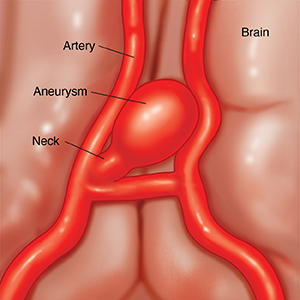
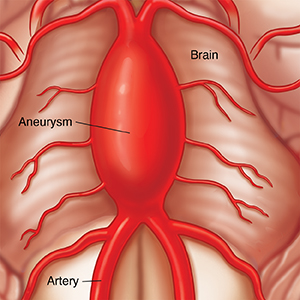
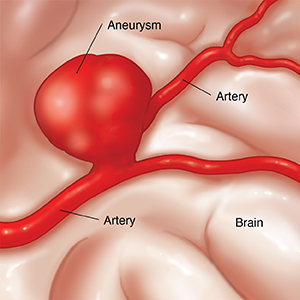
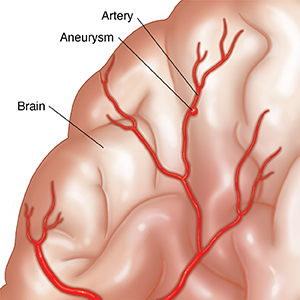
There are several types of brain aneurysms that are classified by shape. These are saccular (also called berry) aneurysms, which are by far the most common. Less common are the fusiform and dissecting types. Brain aneurysms may also be classified by:
-
Size (small, large, and giant)
-
Location
-
Cause (such as a mycotic aneurysm, caused by an infection)
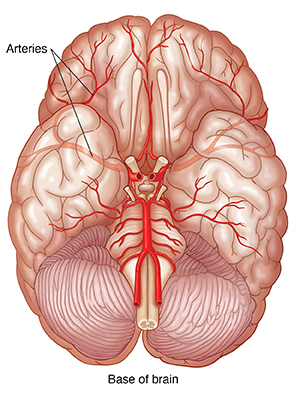
Most aneurysms occur where an artery branches, often at the base of the brain. The risk of an aneurysm bursting (rupturing) can be affected by the shape and location of the aneurysm. The treatment options vary, depending on the type of aneurysm, its size, and its location.
Online Medical Reviewer: Chris Southard RN
Online Medical Reviewer: Marianne Fraser MSN RN
Online Medical Reviewer: Melinda Murray Ratini DO
Date Last Reviewed: 03/01/2024
© 2000-2025 The StayWell Company, LLC. All rights reserved. This information is not intended as a substitute for professional medical care. Always follow your healthcare professional's instructions.
Find the right provider to meet your needs
From primary care to specialty services and more.
Find a Doctor
Call for an Appointment
Offering personalized care at more than 20 clinics across three cities and two states.
Call NowRelated Articles
Ependymoma
Ependymoma is a rare type of tumor of the brain or spinal cord. It can happen in both children and adults. In children, these tumors tend to be in the brain. In adults, they are often in the spinal cord.
Normal Pressure Hydrocephalus
Normal pressure hydrocephalus is excess cerebrospinal fluid buildup in the brain ventricles. It may develop from infection, bleeding, injury, or surgery.
Transverse Myelitis
Transverse myelitis is inflammation and scarring of the spinal cord that causes pain and weakness in the body.
Early-Onset Alzheimer Disease
Alzheimer disease most commonly affects older adults. But it can also affect people in their 30s or 40s. When Alzheimer disease occurs in someone younger than age 65, it is known as early-onset (or younger-onset) Alzheimer disease.