Bell's Palsy is a weakness or paralysis of the facial muscles from damage or trauma to the facial nerves.
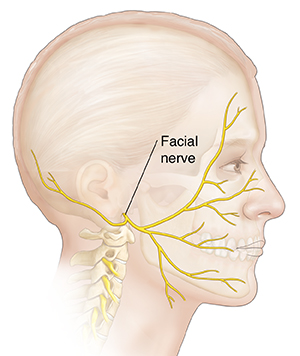
In most cases, the cause is unknown. But it may be related to inflammation of the nerve, diabetes, pregnancy, Lyme disease, or viral infections such as herpes or varicella. Symptoms usually appear only on 1 side of the face. They may include:
-
Inability to close the eyelid
-
Tearing of the eye
-
Facial drooping
-
Drooling
-
Pain in the jaw or behind the ear
-
Changes in taste
-
Sound sensitivity
-
Facial twitching
-
Headache
-
Trouble eating or drinking
-
Problems speaking
Damage to the eye can be a serious problem. The inability to blink can cause the eye to dry out. An ulcer (sore) can then form on the cornea. Also, not blinking means that the eye has no protection from dirt and dust particles.
Treatment involves protecting and moistening the eye. Medicines, such as steroids, may also help.
How long it takes to recover depends on how severe the nerve damage is. Most people begin to get better within a few weeks. They recover fully within 3 to 6 months. In rare cases, some people have weakness that doesn’t go away. Sometimes the condition returns months or years later.
Home care
-
Get plenty of rest and eat a healthy diet to help yourself recover.
-
Use artificial tears often during the day and at bedtime to prevent drying. These drops are available without prescription at your drug store.
-
Wear protective glasses, especially when outside to protect from flying debris. Use sunglasses when outdoors.
-
Wear an eye patch at night to protect the eye. A lubricant at bedtime can keep the eye moist overnight.
-
Sometimes medicines are prescribed to reduce inflammation or treat specific viral infections of the nerve. If medicines are prescribed, take them exactly as directed. Usually, the sooner the medicines are started, the more effective they are. Taking the medicine as prescribed will help with a full recovery.
-
Use low heat, such as from a heating pad, on the affected area. This can help reduce pain and swelling.
-
If you have severe pain, contact your healthcare provider.
Follow-up care
Follow up with your healthcare provider as advised. If you were referred to a specialist, make that appointment right away.
When to seek medical advice
Call your healthcare provider if any of the following occur:
-
Severe eye redness
-
Eye pain
-
Thick drainage from the eye
-
Change in vision, such as double vision or losing vision
-
Fever of 100.4°F (38°C) or higher, or as directed by your healthcare provider
-
Increasing headache, neck pain, weakness, or trouble speaking or walking
Online Medical Reviewer: Joseph Campellone MD
Online Medical Reviewer: Raymond Kent Turley BSN MSN RN
Online Medical Reviewer: Rita Sather RN
Date Last Reviewed: 09/01/2024
© 2000-2025 The StayWell Company, LLC. All rights reserved. This information is not intended as a substitute for professional medical care. Always follow your healthcare professional's instructions.
Find the right provider to meet your needs
From primary care to specialty services and more.
Find a Doctor
Call for an Appointment
Offering personalized care at more than 20 clinics across three cities and two states.
Call NowRelated Articles
Cluster Headache
A cluster headache is different from a migraine or a tension headache. Learn about symptoms, triggers, and treatments for a cluster headache.
Brain Cyst
A brain cyst is an abnormal fluid-filled sac in the brain. A cyst may contain blood, pus, or other material. In the brain, a cyst may contain cerebrospinal fluid (CSF). CSF normally bathes and cushions the brain and spinal cord. Often, a brain cyst begins before birth.
Ulnar Nerve Palsy
Ulnar nerve palsy is caused by damage to the ulnar nerve, which controls movement and feeling in the wrist and hand.
Normal Lumbar Puncture
Read on to learn how to care for yourself at home after a lumbar puncture.