Back or neck pain may be due to problems with certain nerves near your spine. If so, a medial branch neurotomy can help ease your pain. Neurotomy destroys a nerve to relieve pain or stop involuntary movements. In some cases, your healthcare provider may give you a nerve block to see how your body will respond to neurotomy. The treatment uses heat, cold, radiofrequency, or chemicals to destroy the nerves near a problem joint. This keeps some pain messages from traveling to your brain and helps ease your symptoms.
Medial branch nerves
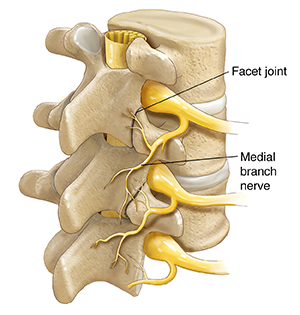
Each vertebra in your spine has facets (flat surfaces). They touch where the vertebrae fit together. This forms a facet joint. Each facet joint has at least 2 medial branch nerves. They are part of the nerve pathway to and from each facet joint. A facet joint in your back or neck can become inflamed (swollen and irritated). Pain messages may then travel along the nerve pathway from the facet joint to your brain.
Blocking pain messages
Medial branch nerves in each facet joint send and carry messages about back or neck pain. Destroying a few of these nerves can keep certain pain messages from reaching your brain. This can help bring you relief. The relief typically lasts for months to years.
Risks and complications
Risks and complications are rare. But they can include:
-
Infection
-
Increased pain, numbness, or weakness
-
Nerve damage
-
Bleeding
-
No relief of pain
Online Medical Reviewer: Jimmy Moe MD
Online Medical Reviewer: Ronald Karlin MD
Online Medical Reviewer: Tara Novick
Date Last Reviewed: 10/01/2024
© 2000-2025 The StayWell Company, LLC. All rights reserved. This information is not intended as a substitute for professional medical care. Always follow your healthcare professional's instructions.
Find the right provider to meet your needs
From primary care to specialty services and more.
Find a Doctor
Call for an Appointment
Offering personalized care at more than 20 clinics across three cities and two states.
Call NowRelated Articles
Lumbar Drain Placement
A lumbar drain is a soft, thin, sterile tube (also called a catheter) that your healthcare provider places though the skin of your back, into your lower (lumbar) spine. The drain collects cerebrospinal fluid (CSF). This is a clear fluid that surrounds your spinal cord and brain to protect them from injury. Read on to learn more about lumbar drain placement and how it’s done.
First Aid: Head Injuries
A strong blow to the head may cause swelling and bleeding inside the skull. The resulting pressure can injure the brain (concussion).
Spinal Fusion: Understanding Bone Graft
To fuse the spine, very small pieces of extra bone are needed. Called bone graft, this bone acts as the “cement” that fuses the vertebrae together. There are many different types of bone grafts. The fusion eliminates motion between the two fused vertebrae with a slight loss in flexibility. This surgery can help treat many different back conditions.
Understanding Radiofrequency Denervation
Radiofrequency denervation is a treatment for some kinds of lower back and neck pain. It uses an electrical current created by radio waves.