Exercise is a vital part of maintaining balance, flexibility, and mobility in those with Parkinson disease. Exercise can also help you continue with the activities of daily living. Generally, a mix of 4 types of exercises may be used:
-
Aerobic activity
-
Strength training
-
Balance
-
Flexibility
Your healthcare provider or physical therapist will work with you to develop an exercise program that is right for you, based on your symptoms and challenges. Some common exercises illustrated below may be a good place to start.
How often should I exercise
Do the exercises once a day at first, then build up to several times a day. Being consistent is important. Exercise slowly, and stop if you feel pain. Studies have shown that those exercising earlier in their disease course for at least 2.5 hours per week have a better quality of life.
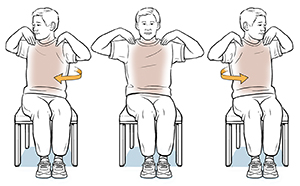
Body twist
Follow these steps:
-
Sit in a chair, facing forward. Place your hands on your shoulders.
-
Turn your head and body to the side as far as possible, as if you were trying to look behind you.
-
Return to starting position, then turn to the other side.
-
Repeat 10 times.
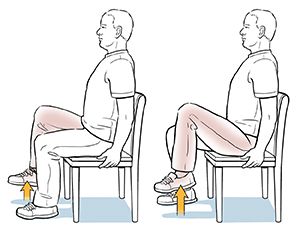
Seated march
Follow these steps:
-
Sit in a chair, facing forward.
-
Slowly lift one knee as high as you can, then lower your foot to the floor.
-
Do the same with your other leg.
-
Repeat 10 times with each leg.
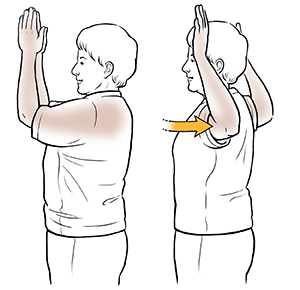
Back stretch
Follow these steps:
-
Stand or sit with your back straight.
-
Hold your arms in front of you. Put your hands and elbows together, hands pointing toward the ceiling.
-
Move your arms apart as far as possible, pushing your shoulder blades together.
-
Slowly move your hands back together.
-
Repeat 10 times.
Online Medical Reviewer: Anne Fetterman RN BSN
Online Medical Reviewer: Marianne Fraser MSN RN
Online Medical Reviewer: Rita Sather RN
Date Last Reviewed: 04/01/2024
© 2000-2025 The StayWell Company, LLC. All rights reserved. This information is not intended as a substitute for professional medical care. Always follow your healthcare professional's instructions.
Find the right provider to meet your needs
From primary care to specialty services and more.
Find a Doctor
Call for an Appointment
Offering personalized care at more than 20 clinics across three cities and two states.
Call NowRelated Articles
Living with Parkinson Disease
You have a number of tools at your disposal for better managing the symptoms of Parkinson’s disease and living a healthy, enjoyable life.
Migraine: It's Time to Call Your Healthcare Provider
If your migraine pattern changes or your headaches suddenly feel different, it could be a sign of a more serious medical condition.
Parkinson Disease: Managing Day to Day
Parkinson disease can make daily life harder. But certain changes and devices can help you stay independent and active. The following tips suggest ways to handle problems with some daily activities.
Problems with Thinking Skills After Brain Injury
After a brain injury, a person may be less able to coordinate sequential activities, process thought, and use language. At first, therapy may be provided by medical professionals and therapists. But often longer-term support by family and friends is needed. Read on to learn more.