Treatment
AEDs: High-Tech Help for Cardiac Arrest
You've seen it time and again on TV shows. After someone suffers sudden cardiac arrest, healthcare providers grab the paddles and deliver an electric shock to the patient to help restore a normal heart rhythm.
Technology has given us the automated external defibrillator (AED). This is a small, lightweight, battery operated, portable defibrillator. You may see these devices in schools and public buildings, airports, malls, sports arenas, health clubs, golf courses, and some businesses.
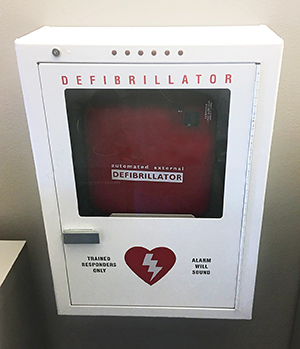
Defibrillation is needed when a heart starts to beat abnormally and so fast that very little blood can be pumped out of the heart to the rest of the body. This might result in cardiac arrest. An AED uses an electric shock to help the heart return to its normal rhythm.
Here are some FAQs to help bring you up to speed.
What is an automated external defibrillator?
The automated external defibrillator (AED) is a computerized medical device. It's battery powered with adhesive defibrillator pads that are applied to the chest to allow an electrical current to pass through to the heart to reset the heart's normal electrical current. A normal, regular or organized electrical rhythm through the heart is necessary for the muscle to contract and pump blood to the body.
When a person is in cardiac arrest, they have either no electrical current, a rapid rhythm that doesn't allow for the heart pumping chambers to fill correctly (ventricular tachycardia), or a disorganized electrical rhythm or current that doesn't allow the heart muscle to contract and circulate blood to the body (ventricular fibrillation). Ventricular fibrillation and ventricular tachycardia can be stopped with an electric shock to restore normal heart rhythm and circulation to the body. This is called either cardioversion or defibrillation.
An AED can check a person's heart rhythm through monitors that are in the defibrillator pads, so you don't have to be a trained expert to recognize irregular heart rhythms to save someone's life using an AED. The AED can recognize a rapid or irregular heart rhythm that needs a shock. And it can advise the rescuer when a shock is needed. The AED uses voice prompts, lights, and text messages to tell the rescuer the steps to take.
AEDs are very accurate and easy to use. There are many different brands of AEDs, but the same basic steps apply to all of them. The American Heart Association doesn't recommend a specific model.
Do you need training to use an AED?
No. Most anyone with or without a medical background can learn to use an AED or apply the pads correctly and administer a shock by following the prompts provided by the AED. Usually, people learn to use an AED in a course that also teaches CPR. The computerized device will tell a rescuer to push the defibrillate button if cardiac arrest is from an abnormal heart rhythm that could respond to a shock. (Not all rhythms will.) This could be either ventricular fibrillation or ventricular tachycardia. Ventricular fibrillation is the most common heart-rhythm problem in victims of sudden cardiac arrest.
Won't the cost of devices like AEDs keep them out of most places?
No. The cost of AEDs has decreased a lot in the past few years. Many of these devices and the replacement components cost about $1500 to $2000.
Are AEDs really needed in places other than hospitals?
The rate of sudden cardiac death can be reduced by placing AEDs in the community and by teaching people how to use them. Seconds and minutes count when cardiac arrest occurs. The likelihood of survival decreases for every minute that goes by without this type of help.
Is an AED useful for all types of cardiac arrest?
No. Other abnormal rhythms like a very slow heart rate or no electrical rhythm at all, can't be treated with an AED. When a user puts the AED's electrodes or adhesive pads on a victim's chest, the device determines whether the patient's heart needs to be shocked or not. Then the AED will instruct the rescuer about the next steps. Many of the newer models talk the rescuer through the steps. They automatically deliver the shock if appropriate.
Do AEDs mean CPR is no longer needed?
Absolutely not. They go together to correctly resuscitate someone having a cardiac arrest. An AED can restore a normal heart rhythm in certain cases. Chest compressions in CPR are used to help keep blood flowing through the heart and the body. CPR can double the chances of survival when used correctly when a person collapses and just before an AED delivers a shock. CPR should be started while someone else gets the AED.
Does research back the community use of AEDs?
Yes. One study looked at the survival rates of people who had sudden cardiac arrest from ventricular fibrillation in casinos and got AED treatment from security personnel. There was a 75% survival rate for people who got their first shock within 3 minutes compared to a 50% survival rate for those shocked after more than 3 minutes.
Author: Bramnick, Jeffrey
Online Medical Reviewer: Callie Tayrien RN MSN
Online Medical Reviewer: Stacey Wojcik MBA BSN RN
Online Medical Reviewer: Steven Kang MD
Date Last Reviewed: 01/01/2023
© 2000-2025 The StayWell Company, LLC. All rights reserved. This information is not intended as a substitute for professional medical care. Always follow your healthcare professional's instructions.
Find the right provider to meet your needs
From primary care to specialty services and more.
Find a Doctor
Call for an Appointment
Offering personalized care at more than 20 clinics across three cities and two states.
Call NowRelated Articles
First Aid: Heart Attacks
A heart attack is an emergency, but the condition that causes it usually takes years to develop. Over time, fatty substances collect on the walls of the heart's arteries. As these arteries become narrower, it's more likely that one will become fully clogged, causing a heart attack.
Laceration of an Arm or Leg: Stitches, Staples, or Tape
A laceration is a cut through the skin. If it is deep, it may need stitches or staples to close so it can heal. Minor cuts may be treated with surgical tape closures.
Foreign Object Under the Skin (Removed)
An object, or foreign body, has been removed from under your skin. Although care was taken to remove all particles present, there is always a chance that a small piece may have been left behind. Here's how to care for yourself at home.
Accidental Ingestion: Nontoxic (Adult)
Accidentally taking too much of a medicine or swallowing a chemical product may be harmful. Follow these instructions if there is no sign of toxic effects.